Using AI To Create Assignments
1June 21, 2024 by Dr. Robbie Barber
I have read many comments that teachers need to teach critical thinking more and less facts. I am not convinced that the state testing agrees. Personally, I think there are many things we need to memorize to provide background knowledge that we build on as we learn. One example is to memorize the multiplication tables in third grade to be able to handle algebra and higher-level mathematics. How do we change our assignments to use AI and strengthen our knowledge base? Let’s look at three different artificial intelligence programs to try this out. (Note: This blog post is in response to Week 2 of #8weeksofsummer challenge with the question “How will you use AI to lesson plan?”)
Before we begin, let me make a couple of items clear. One, I will sign in to any of these AI systems with my school Google or Microsoft account; not my personal account. Two, I am not asking or requiring students to sign in. We will talk in another post about student use of AI.
Many of my 11th graders take Multicultural Literature. Often, they read The Kite Runner by Khaled Hosseini as one of their books. Before assigning an essay or paper, what if we let AI help create the rubric? MagicSchool.AI allows you to create a rubric by putting in the standards and any specifics you may require.
To create the rubric, I’ll start with an ELA standard: ELAGSE11-12W7 – Conduct short as well as more sustained research projects to answer a question (including a self-generated question) or solve a problem; narrow or broaden the inquiry when appropriate; synthesize multiple sources on the subject, demonstrating understanding of the subject under investigation.

MagicSchool.AI’s Rubric Generator
I made this assignment with a requirement of only two articles for research and a 3-point scale. All of this is adjustable. In the additional customization, I added the importance of punctuation and grammar. (I did misspell grammar as ‘grammer’. Whoops!)
Here is the rubric, which was created in about 30 seconds.

I’m quite relieved that even though I misspelled “grammar”, it correctly interpreted it and included the correct word. I could go back and edit my prompt after I got the results if I needed to fix it. I can also copy and paste this into Word or Google Docs and edit it since I probably want to emphasize creating a research question (before you can grade it!). I can also make my own rubric from scratch, but why?!
Another ELA suggestion is to have students engage in a Socratic debate with ChatGPT as a way of thinking through a question and articulating an argument (D’Agostino). This requires students to actually have an account and use AI themselves. Even though Federal rules apply to those under 13 years old, I would recommend making 16 years old the minimum age to do this. Students need to thoroughly understand all of the privacy issues.
If you are a science teacher, maybe you want students to write a short paper describing how light travels. Instead, consider going to an AI, like Perplexity.AI, and have the AI system write a short paper. Perplexity.AI is pretty neat because it proves the sources. However, you can give the resultant paper to your students (without the sources) and ask them to write a paper explaining what the AI system got right and wrong with sources the students find. You are stepping up the game to have the students critically analyze the AI paper. And, if you like to cheat (!), edit the paper before giving it to students and change some things on purpose to have them find. It can be the most astonishing and engaging scavenger hunt.

Diffit is designed to provide differentiated materials for different student needs, including changing languages. Diffit, like Perplexity.AI, provides sources – something I love to have. I started by just grabbing a math standard and saying it was 6th-grade level.
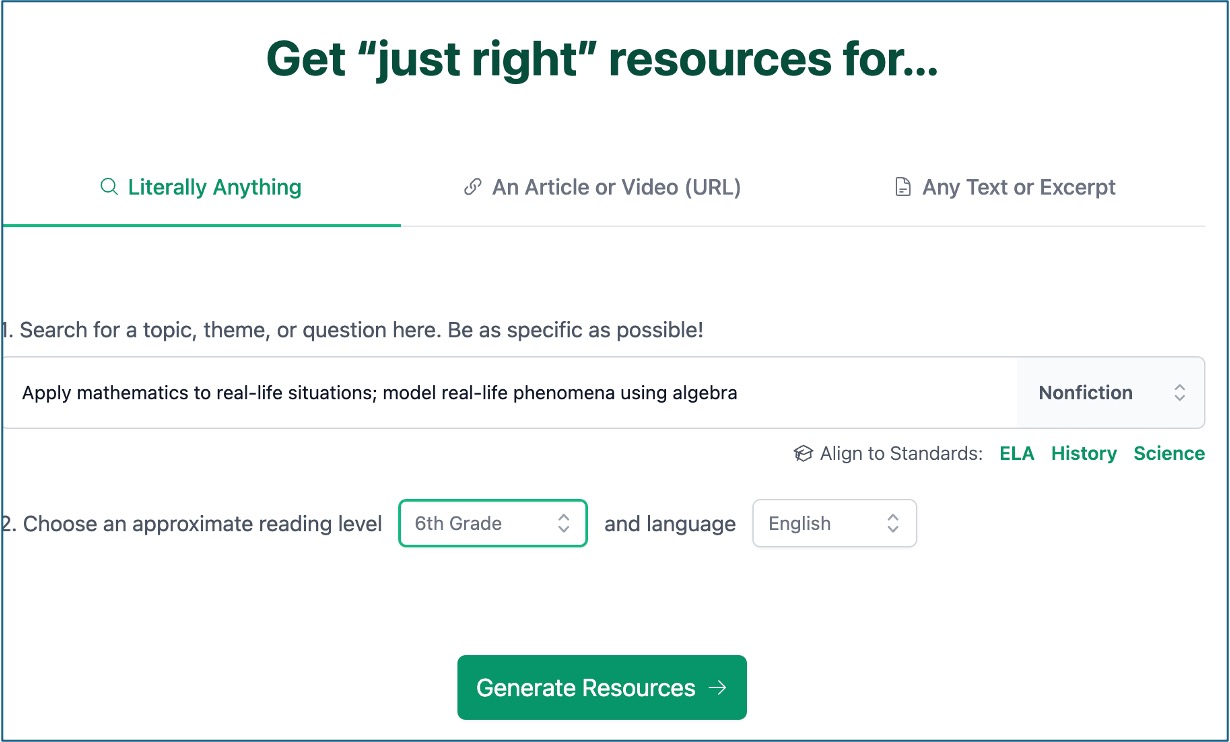
Each time I generated this, I changed the level. I would get the following: Adapted reading passage (with sources), a summary, vocabulary words, multiple choice questions, short answer questions, and open-ended prompts.
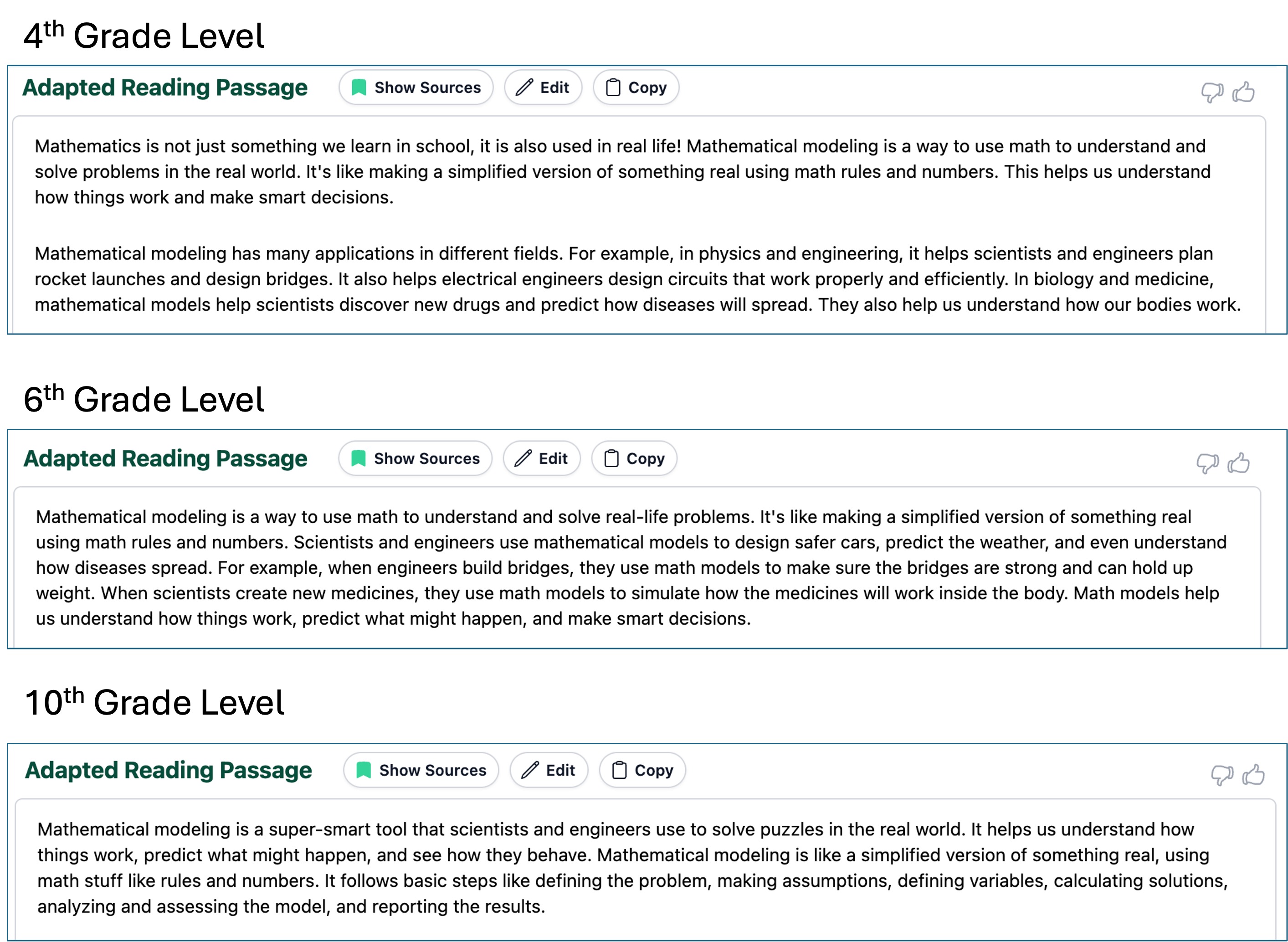
Just to see the differences, here are 4th-grade, 6th-grade, and 10th-grade levels of the start of the Adapted Reading Passage with the same prompt: Apply mathematics to real-life situations; model real-life phenomena using algebra.
Trying new stuff out should be fun, not agonizing. MagicSchool.AI knows this and has a Teacher Joke section.
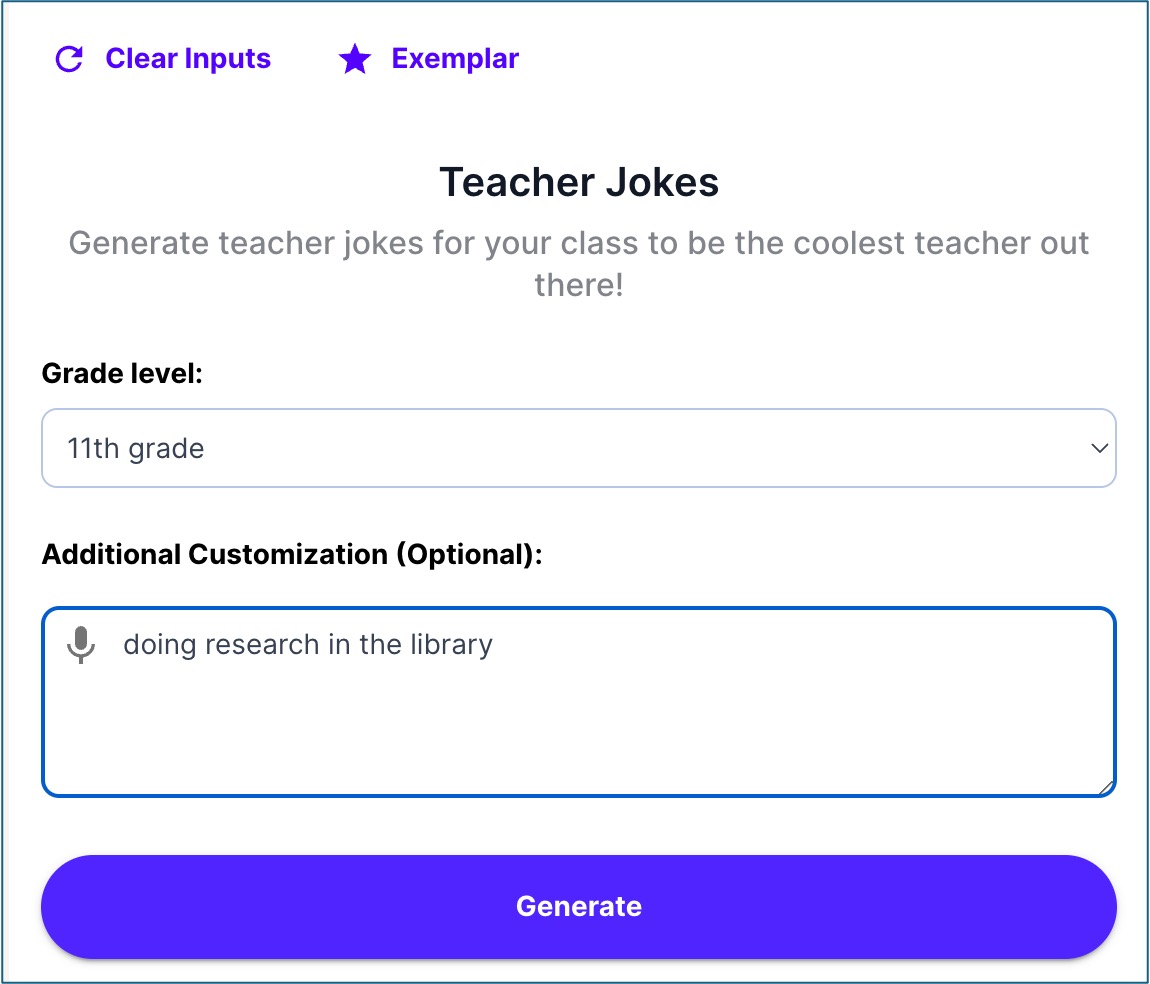

Yes, I will use the 3rd one just to annoy my students. 😊
References:
Chiu, T. K. F. (2021). A Holistic Approach to the Design of Artificial Intelligence (AI) Education for K-12 Schools. TechTrends: Linking Research & Practice to Improve Learning, 65(5), 796–807. https://doi.org/10.1007/s11528-021-00637-1
D’Agostino, S. (2023, January 30). Designing Assignments in the ChatGPT Era. Higher Education News, Events and Jobs. https://www.insidehighered.com/news/2023/01/31/chatgpt-sparks-debate-how-design-student-assignments-now
 Tickling Tech
[…] in a School Library? Accessibility with AI Guiding Students in Using AI Using AI To Create Assignments Teaching That AI Is Biased AI Is […]
LikeLike