Teaching AI Environmental Impact
1July 11, 2025 by Dr. Robbie Barber
At a recent conference, I gave a presentation about images and image manipulation. I then added artificial intelligence (AI) image creation. I showed a small part of John Oliver’s recent AI Slop segment. AI Slop is a reference to the high volume of low-level image creation that is currently found everywhere on the internet, including websites like Pinterest. The question was asked about the environmental impact of these AI images. In all honesty, I didn’t have an answer. Now, I hope to learn with my students.
If there was any doubt about the power needs of AI, the news that Microsoft was reopening the Three Mile Island nuclear facility was enough to settle the issue. AI requires a lot of power. According to the International Energy Agency (IEA), in 2024, some AI data centers required over 100 MW of electricity, equivalent to the annual needs of approximately 100,000 homes.
The volume of resources needed for generative AI and particular image generation is incredible. It needs more electricity, which may increase the use of fossil fuels. It requires more water.
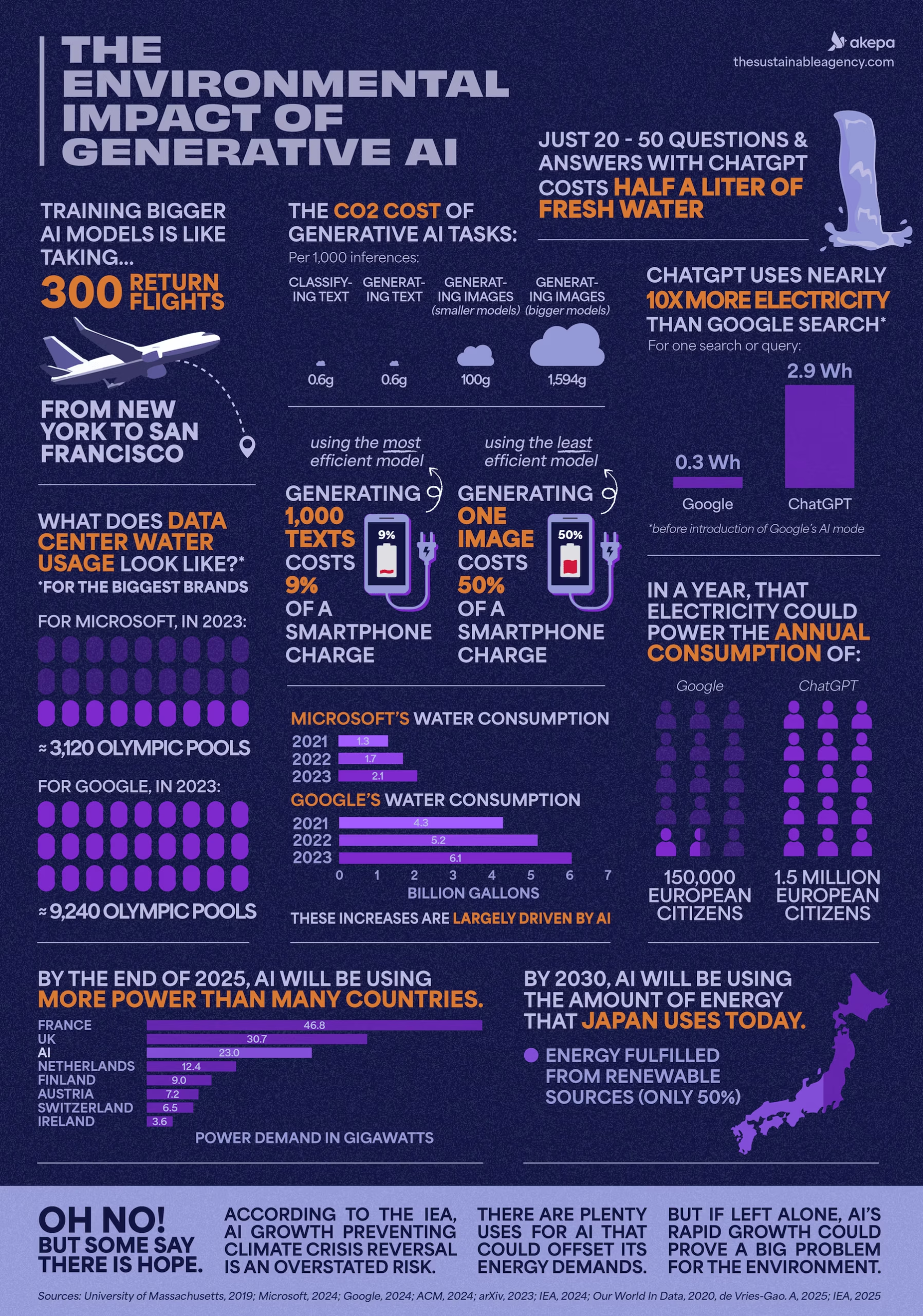
While it’s clear from this data that AI-generated images require a significant amount of electrical power, it’s also evident that students are using them, whether or not they are taught by you. During my presentation, a high school student was sitting at a table near where I stood. She made comments, showed me images she created during the presentation, and afterwards said she was already using a lot of these things we talked about. We need to be teaching students about AI-generated images and other materials. They are using them. It is incumbent on us to provide assistance in analyzing and distinguishing AI-generated materials and the effect it has on the environment.
When teaching, we need to provide some interactions. If I get to see students in a lesson, I can create discussion groups. However, if I am just trying to flag their attention, I need a passive programming (a.k.a. self-directed) activity. I will put up displays with bullet points on certain items. I will hang sets of two pieces of paper on the wall. The top page will show a question about AI Environmental issues. The page behind it will reveal the answer. I may include QR codes for some of the videos.
Below are some resources I will use to create my activity:
- The Economist Educational Foundation produces Topical Talk Headline with materials and activities for students (and faculty). https://talk.economistfoundation.org/resources/ai-and-sustainability-difficult-choices/
- AI for Education provides a PDF with information and discussion questions. https://www.aiforeducation.io/ai-resources/ais-impact-on-the-environment
- California Educators Together has a lesson with videos and discussion questions (written by Jennifer Elemen): https://www.caeducatorstogether.org/lesson-plans/6nfgavoi/ai-environmental-impact
- Andy Kratochvil has a lesson he posted that includes a PBS video and some summary images to help understand the issue. He includes discussion questions and an activity of mapping data centers. https://sharemylesson.com/todays-news-tomorrows-lesson/ai-environmental-impact
As I put together materials, I want to brainstorm methods of creating a discussion with the materials I have at hand. I wonder if students could submit Instagram-ready posts or reels that I could share with their thoughts and considerations. I don’t know what the final shape will be, but I know it needs to start this school year.
Additional References:
Dhanani, R. (27 September 2024). Environmental impact of generative AI – 20+ stats & facts. https://thesustainableagency.com/blog/environmental-impact-of-generative-ai/
The International Energy Agency (IEA). 2024. A transformative technology with important implications for energy: Artificial intelligence. https://www.iea.org/topics/artificial-intelligence
Luccioni, A. S., Jernite, Y., and Strubell, E. (2024.) Power hungry processing: Watts driving the cost of AI deployment? In ACM Conference on Fairness, Accountability, and Transparency (ACM FAccT ’24), June 3–6, 2024, Rio de Janeiro, Brazil. ACM, NewYork, NY, USA, 21 pages. https://doi.org/10.1145/3630106.3658542 https://arxiv.org/pdf/2311.16863
Zewe, A. (17 January 2025). Explained: Generative AI’s environmental impact. https://news.mit.edu/2025/explained-generative-ai-environmental-impact-0117
Some of my previous posts on AI
 Tickling Tech
[…] Part I: Teaching AI Environmental Impact […]
LikeLike