Teaching How ‘NOT’ To Present
1September 21, 2025 by Dr. Robbie Barber
How do you teach students to be able to make confident, succinct presentations in class? How do you teach colleagues to do the same? I am certain that every teacher has heard a presentation filled with sentences of information and a student reading directly from notes. It’s painful.
Students (of all ages) need to take time to organize their information and thoughts first. They think about why they are giving a presentation. (They may NOT answer “because my teacher told me to!”) Instead, consider the five reasons presented by Patricia Ward Brash (1992):
- To inform;
- To persuade;
- To inspire;
- To motivate to action; or
- To entertain.
I teach students how to present by having them define the presentation skills needed. It’s pretty simple and takes between 5-15 minutes.
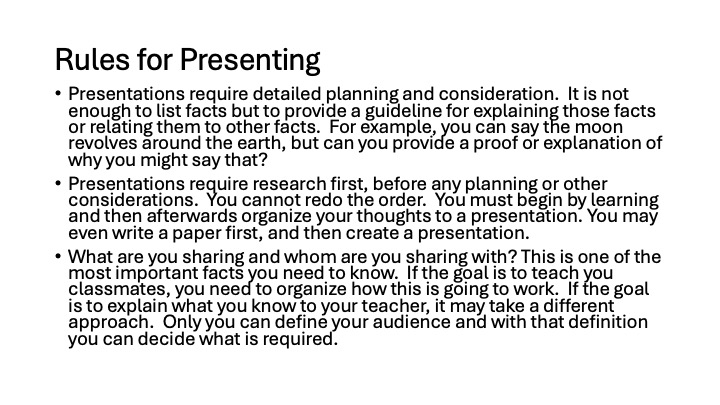
Students sit in their seats facing the big electronic board in the classroom or library. I tell them I need to review how to present the results of their work. I start my PowerPoint (Slides, whatever) and turn my back on the students. On the screen is a slide with full sentence bulletin points. I look at the board and read aloud, softly. After a minute or two, one student is usually bold enough to tell me she can’t hear me. I start shouting the words as I continue to read. I have two slides with small type, full sentences, in case they’re slow in correcting me. Eventually, they tell me to turn around. They tell me I have to face them for a presentation. I immediately agree, pick up my notes, and hold them in front of my face as I continue to read aloud. The students continue to correct me.
Once the students decide they have corrected my presentation skills, it’s time to dig into the presentation’s visual appeal. I have a screen with a garish background and different colors for every bullet point. I could talk to them about the color wheels and what looks good on a screen. But seeing is believing. If we’re in the library, there are a lot of windows, and a light background color does not work well on the screen. If we’re in the classroom, the main light may be from fluorescent lights, which may change the best background color. Do not assume that students instinctively know how colors mix well. They may have favorite colors and assume that’s the best thing.

Start with the assumption that the audience is either classmates or colleagues. Many professional presenters change their talks with their audience. For our purposes, we will keep the audience simple.
Bullet lists with clip art in the corner are not appealing. Do. Not. Write. In. Full. Sentences. White space is the blank area on the slide – it helps focus your attention on the important items. Keep in mind that a presentation is a marriage of the display on the screen and your speaking. Your audience CANNOT listen and read at the same time.
And, practice, practice, practice! I strongly encourage my students and teachers to practice saying their presentation out loud. It sounds different aloud than the soundtrack in your head. 😉
I also recommend using various design templates. You can find template galleries in PowerPoint, Slides, and Canva. You can also go to SlidesCarnival, SlidesMania, and SlidesGo, to name a few FREE options.
I personally enjoy giving live presentations at conferences. But it was something that grew over time. As a high school student, this would have been terrifying to me. I can honestly relate to Jerry Seinfeld’s words:

References:
Barber, R. (2021). How NOT to present. Teach Library and Information Literacy with a Sense of Humor: Why (and How to) Be a Funnier and More Effective Library and Information Literacy Instructor and Laugh All the Way to Your Classroom? [ISBN 978-1-925128-04-8].
Brash, P. W. (1992). Beyond giving a speech. Vital Speeches of the Day, 59(3), 83.
 Tickling Tech
Hi Robbie! I so enjoyed connecting you at the AASL Conference this weekend. I was so busy taking notes during your presentation that I missed grabbing the link. Would you be willing to share your slides from “Who Blamed the Cow?”? I would greatly appreciate it.
Thank you for your consideration! I look forward to chatting soon.
Jordan West from Darlington School in Rome, Ga. (jwest@darlingtonschool.org)
LikeLike