AI Can Find You Via YOUR Images
Leave a commentJuly 6, 2026 by Dr. Robbie Barber
You can control your location information inside various apps, if you choose, by turning off the location. The default is always sharing location. Sometimes, it helps to have the location turned on, so that mapping apps know where you are in relation to your destination. Sometimes, it is better not to let the apps follow you around.
When you upload an image to the internet (social media, cloud drive, etc.) it will carry with it the location information. Yes, you can turn off the location information, but it isn’t enough to protect you. GeoAI, or geospatial artificial intelligence, is a marriage of AI and all of the information surrounding the space that is working with AI (Gumilar et al, 2024). This means it will gather information on location (computer/phone IP or an image you upload). It knows where you are located when you ask a question (Privacy International, 2026). GeoAI will investigate your social media from the device that is asking AI for something. Plus, in testing systems, Grainge et al. (2025), discovered that these systems discover locations BETTER if you use social media. It implies a bias in AI to look for people-centric images to determine location.
“Visual content shared online, even when stripped of explicit location markers, can be reverse-engineered to reveal precise locations. Users typically lack both awareness and control over how such inferences are made” (Grainge et al., 2025, p. 167).
What happens if GenAI has your personal data and location? GenAI can target you with specific ads. You may have noticed this already, whenever you use Google to search the internet. It can also use target you in the more specific sense of tracking your movements, profiling you, and potentially feeding you false information (Duffourc et al., 2024). US Federal legislations including the Children’s Online Privacy Protection Act (COPPA) and the Family Education Rights and Privacy Act (FERPA) do not provide enough protections to be effective in the face of a system scooping up massive amounts of data (Duffourc et al., 2024). Once your personal data becomes part of the GenAI system, you cannot necessarily use your rights to remove that personal data.
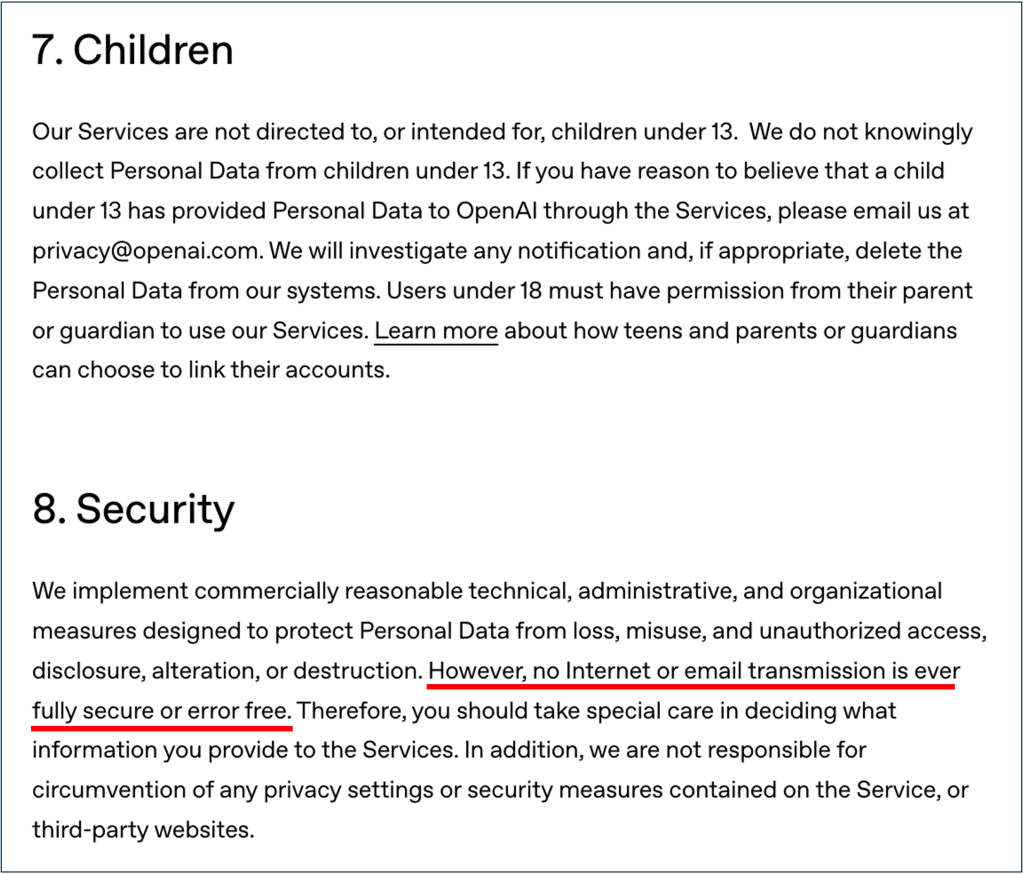
From this snippet on OpenAI’s privacy policy about children, you can see that OpenAI says they will investigate and delete personal data from “our systems”.
It does not mention the 3rd party vendors that OpenAI connects to. In the next section, they immediately deny the safety with a catch-all phrase that nothing is secure.
© OpenAI Privacy Policy as on 03 July 2026: https://openai.com/policies/row-privacy-policy/
Where does that leave my teachers and students? Start by making sure students and teachers know not to share any personal information or personal images (to AI and on social media) to be a little more secure and safe (Grainge et al., 2025). Be upfront and honest, particularly with students. I know a number of my students like to record TikToks. Telling them to stop making videos will not be effective. Instead, I am looking for ways to show them what happens. That’s harder. But lists and tables and charts may help. I’m hoping students can help create the media that attracts attention from other students explaining this problem.
This chart provides a look at what TikTok (and many other products like Google Chrome) collect. Part of the point is to recognize how much information is collected.
TikTok pixels tracks information even if you’ve never used the app (Germain, 2026). Websites are sending TikTok data on anything personal. It’s part of TikTok’s data harvesting empire, of which the app is a only one part (Germain, 2026).
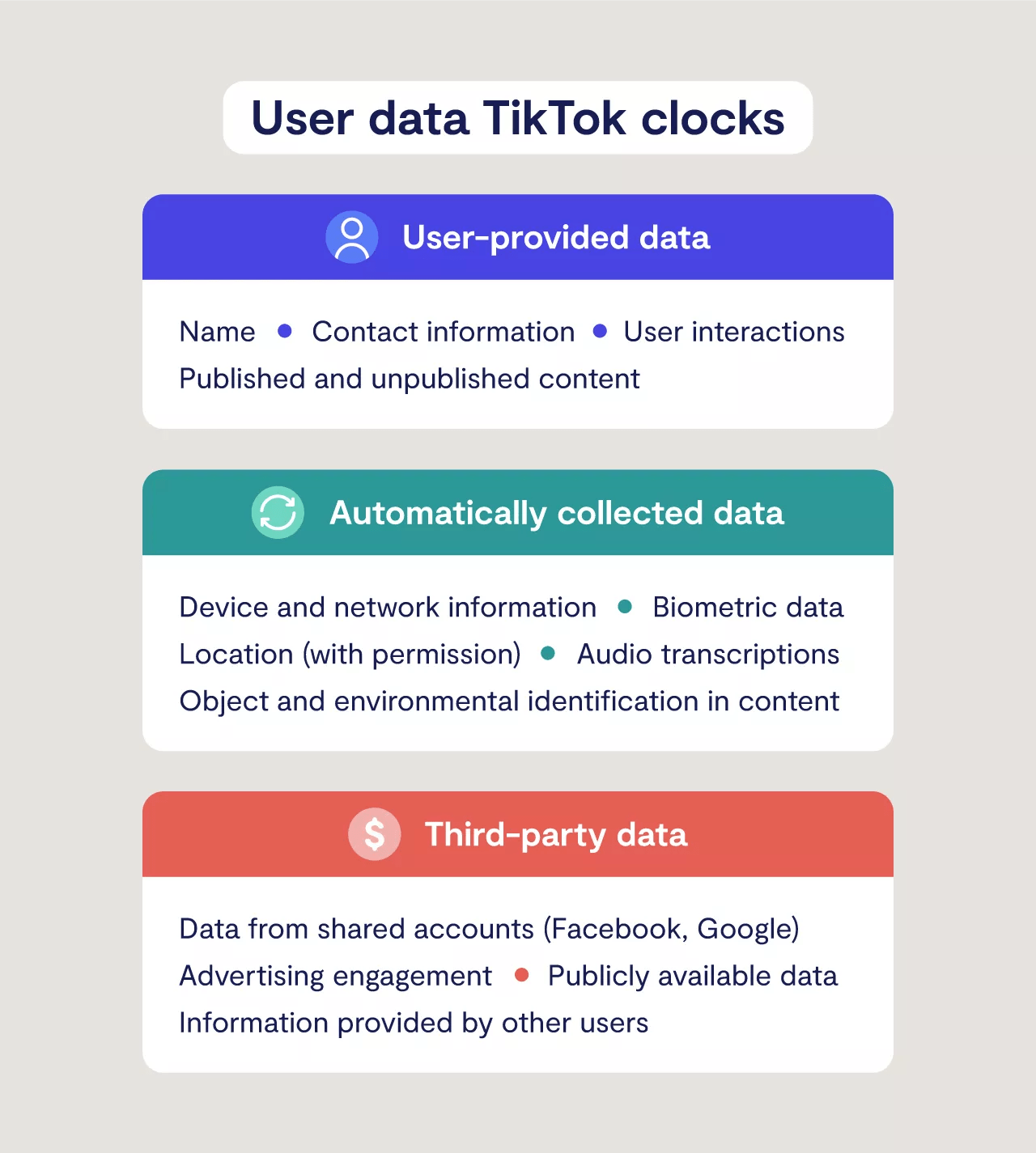
© 2026 Clario Tech FZCO, https://clario.co/blog/tiktok-data/
I do a lot of passive programming where students can look at images and posters outside the library. I want to expand with images or reels on Instagram. If you have ideas on how to teach this information (so it STICKS!), please share. We want reach our patrons of any age.
References:
Duffourc, M. N., Gerke, S., & Kollnig, K. (2024). Privacy of personal data in the Generative AI data lifecycle. Journal of Intellectual Property & Entertainment Law, 13(2), 219–268.
Germain, T. (11 Feb. 2026). TikTok is tracking you, even if you don’t use the app. Here’s how to stop it. BBC.com. https://www.bbc.com/future/article/20260210-tiktok-is-tracking-you-even-if-you-dont-use-the-app-heres-how-to-stop-it
Grainge, O., Waheed, S., Stilgoe, J., Milford, M., & Ehsan, S. (2025). Assessing the Geolocation Capabilities, Limitations and Societal Risks of Generative Vision-Language Models. Proceedings of the AAAI Symposium Series, 7(1), 161–168. https://doi.org/10.1609/aaaiss.v7i1.36882
Gumilar, K. E., Indraprasta, B. R., Hsu, Y.-C., Yu, Z.-Y., Chen, H., Irawan, B., Tambunan, Z., Wibowo, B. M., Nugroho, H., Tjokroprawiro, B. A., Dachlan, E. G., Mulawardhana, P., Rahestyningtyas, E., Pramuditya, H., Putra, V. G. E., Waluyo, S. T., Tan, N. R., Folarin, R., Ibrahim, I. H., & Lin, C.-H. (2024). Disparities in medical recommendations from AI-based chatbots across different countries/regions. Scientific Reports, 14(1), 1–10. https://doi-org.proxygsu-k12d.galileo.usg.edu/10.1038/s41598-024-67689-0
Privacy International (February 2026). Nowhere to hide: Privacy risks and policy implications from geolocation. https://privacyinternational.org/report/5736/nowhere-hide-privacy-risks-and-policy-implications-ai-geolocation

